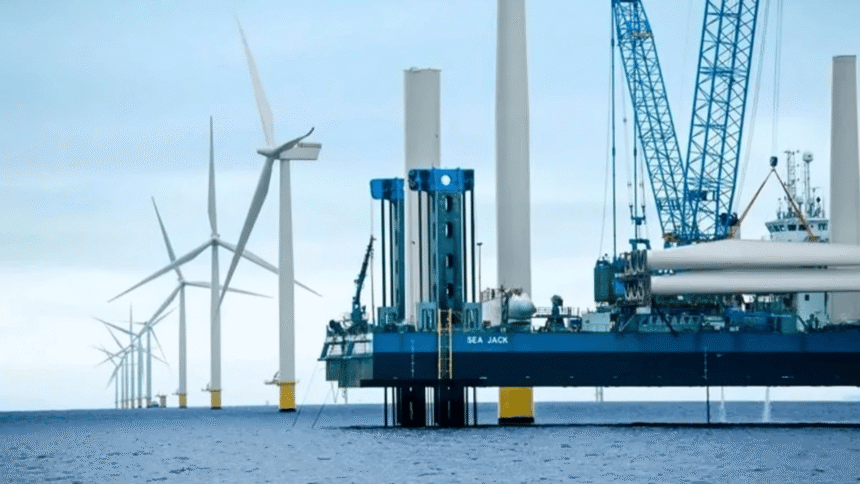
A US federal court has stopped the Trump administration from blocking the last of five suspended offshore wind projects. Construction can now continue, even as legal battles over national security concerns go on. This decision highlights the ongoing conflict between renewable energy growth and government security worries.
Five Suspended Offshore Wind Projects
On December 22, 2025, the Trump administration suspended leases for five major offshore wind projects along the East Coast, citing national security risks, including radar interference from turbine blades. The projects, Vineyard Wind (Massachusetts), Revolution Wind (Rhode Island/Connecticut), Empire Wind (New York), Sunrise Wind (New York), and Coastal Virginia Offshore Wind (Virginia), have a combined capacity of about 6 GW, enough to power 2.5 million homes. The Bureau of Ocean Energy Management (BOEM) ordered at least a 90-day pause, even though the Defense Department had already approved the projects during permitting.
Revolution Wind Court Victory
On January 12, 2026, US District Judge Royce Lamberth decided that BOEM’s stop on Revolution Wind, a $6.2 billion, 704 MW Ørsted project that was 90% finished, was “arbitrary and capricious.” He said the national security reasons given were too vague to justify stopping the project, especially since a September 2025 ruling had already lifted an earlier halt. Ørsted now plans to restart work soon to provide power for 350,000 homes in Rhode Island and Connecticut.
Empire Wind Ruling Details
On January 15, 2026, US District Judge Carl J. Nichols gave a preliminary injunction for Empire Wind, a $5 billion project in New York. He said the suspension would cause serious harm and pointed out that the government did not explain why smaller steps could not address the risks. This decision allows construction to continue on Long Island.
Vineyard Wind and Others Prevail
On January 27, 2026, US District Judge Brian Murphy ruled that Vineyard Wind, an 800 MW project in Massachusetts that is 95% finished, could continue. This was the fourth court order halting the project. Coastal Virginia Offshore Wind, a 2.6 GW project by Dominion Energy, had already won an earlier case. Sunrise Wind is still waiting for a decision, but four of the five projects are now moving forward.
National Security Claims Scrutinized
Interior Secretary Doug Burgum said the pauses were needed because of “emerging adversarial technologies” and radar problems near cities. However, courts found no detailed evidence after the projects had already been approved. Developers and states like New York, Connecticut, and Rhode Island sued, saying the Pentagon had already cleared the projects. Grid operators warned that stopping the projects could hurt reliability and increase costs.
Impacts on Offshore Wind Development
These court decisions help avoid delays that could raise energy bills and cause job losses in states with significant construction activity. Revolution Wind alone provides good jobs and affordable clean energy. Allowing Empire Wind to continue also reduces the risk of canceling the project, especially after Equinor lost $1 billion on a previous project.
Expert Analysis and Outlook
The courts act as a practical check on executive overreach in offshore wind projects. Judges have repeatedly rejected weak security claims, and four quick wins show that the federal permitting process is strong. I believe this helps keep investors confident, which is important for growing renewable energy as demand rises on the East Coast.
Still, the administration may appeal or try new strategies, like removing tax credits. BloombergNEF says this could cut the expected 39 GW of wind power down to 6 GW by 2035. For developers, getting back to work helps avoid serious losses, but connecting fully to the grid depends on BOEM acting quickly. In the end, these projects make the energy system stronger without hurting defense, since radar solutions are already in place, as earlier approvals show.
These legal wins help offshore wind play a bigger part in US energy security and push back against favoring fossil fuels. Courts have made it clear that national security arguments need real evidence, not just talk, so these projects can provide power and jobs on time.
Image Credit – electrek.co