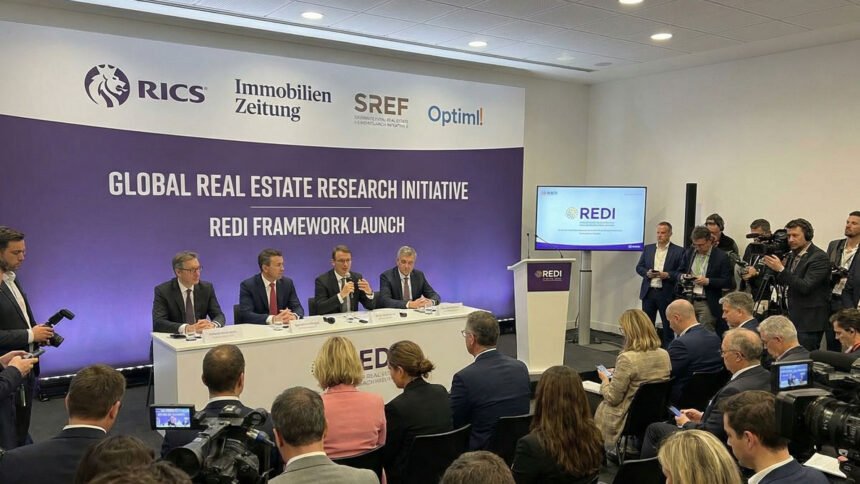
The Royal Institution of Chartered Surveyors (RICS), Immobilien Zeitung (IZ), and the Sustainable Real Estate Forum (SREF) have announced a global real estate research initiative alongside the introduction of a new category, Real Estate Decision Intelligence (REDI), in collaboration with proptech and real estate analytics firm Optiml. The announcement was made in connection with MIPIM 2026, one of the real estate industry’s largest international gatherings.
The initiative is intended to provide structured research, verified case studies, and performance data across global real estate markets. It brings together institutional standards, industry research, and applied technology into a single framework designed to support investment and asset-level decisions.
RICS will contribute its global standards and technical expertise, particularly in sustainability metrics, carbon measurement, and risk management, thereby reinforcing its role in shaping global real estate standards. Immobilien Zeitung will support the initiative through research publication and distribution, including a dedicated research library to share findings with market participants.
SREF will act as a convening partner, bringing together investors, operators, and other stakeholders to support collaboration. Its role includes supporting the use of case studies and practical insights across portfolios.
Alongside the research initiative, Optiml introduced the Real Estate Decision Intelligence (REDI) category, which the company describes as a framework integrating financial analysis, sustainability considerations, and risk assessment into a single decision-making model. According to Optiml, the approach is intended to support real estate professionals in evaluating assets across multiple variables within a single framework, rather than relying on separate tools and reporting systems.
The company states that the platform is designed to help users assess investment strategies by combining financial, environmental, and regulatory data, reflecting a broader shift toward data-driven decision-making. It aims to support capital allocation decisions, retrofit planning, and long-term asset management by providing structured outputs based on available data inputs.
According to Optiml, REDI can be used to generate asset-level scenarios, including potential upgrade pathways, projected financial performance, and estimated environmental impact. These outputs are intended to support internal decision-making processes within investment firms and align with growing ESG-related expectations in real estate investing.
The collaboration also includes participation from several industry organizations, including ALFI, GRESB, Arcadis, Catella, IQ-EQ, KOMPAS VC, and Planon.
The launch reflects ongoing efforts in the real estate sector to address data and regulatory challenges, including evolving sustainability metrics and disclosure standards. Market participants are increasingly expected to consider both financial performance and environmental impact when evaluating assets.
At the same time, many firms continue to rely on separate systems for financial modeling, ESG reporting, and operational analysis. The REDI framework is positioned to bring these elements together into a more unified structure, supported by emerging proptech platforms, though its effectiveness will depend on how widely it is adopted across the industry.
The introduction of a shared research initiative alongside a decision-focused framework reflects a move toward more structured approaches to asset evaluation. By combining standardized research with technology-driven analysis, the collaboration aims to provide a more consistent basis for comparing investment options across markets.
Whether REDI becomes a widely used category will depend on its integration into existing workflows and its alignment with established industry practices. For now, the initiative highlights a growing focus on linking sustainability objectives to financial decision-making in a measurable, practical way.