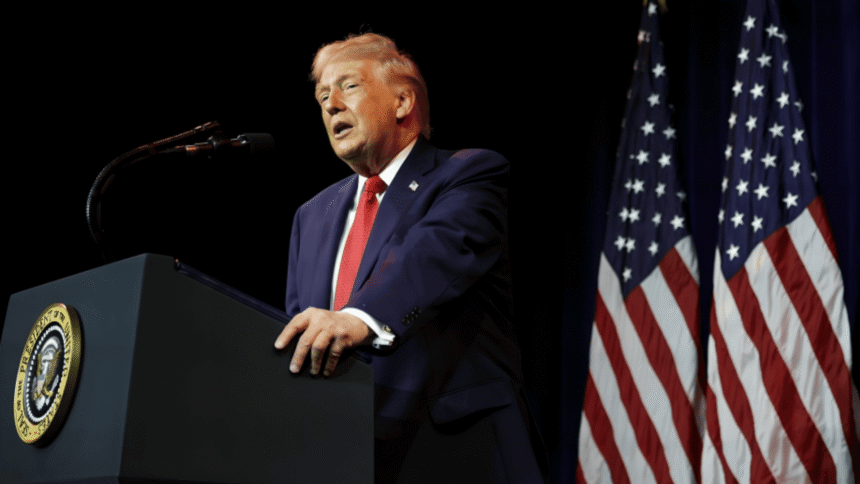
Trump’s housing reform targets large institutional investors buying single-family homes. President Trump aims to ban these corporations to boost affordability for American families. This move addresses concerns over corporate ownership driving up prices.
President Donald Trump announced the ban on January 7, 2026, via Truth Social. He stated, “I am immediately taking steps to ban large institutional investors from buying more single-family homes, and I will be calling on Congress to codify it.” Trump emphasized, “People live in homes, not corporations.”
The policy focuses on “large institutional investors,” such as private equity firms and real estate investment trusts (REITs) like Blackstone and Invitation Homes. It applies to single-family homes, not multi-family or commercial properties. Trump plans to provide more details at the World Economic Forum in Davos, January 19-23, 2026.
Investor Role in Market
Institutional investors hold about 1% of single-family homes nationwide, according to an American Enterprise Institute report. They accounted for over 10% of Q2 2025 transactions, though mostly small buyers. Critics say their bulk purchases reduce supply for individuals, fueling rent hikes and home price surges.
Shares of Blackstone and Invitation Homes dropped up to 9% and 7%, respectively, after the announcement. HUD Secretary Scott Turner praised it as a bold action for affordability. Experts doubt major price drops, citing low investor participation and broader issues such as construction shortages.
Broader Housing Agenda
This ban kicks off Trump’s 2025 reforms, including deregulation, tax incentives via the One Big Beautiful Bill Act (OBBBA), and expanded Low-Income Housing Tax Credits for 1.22 million affordable units. Other ideas: extend mortgages to 50 years, streamline permitting. Tariffs and labor gaps may raise costs by $17,500 per home.
Challenges Ahead
Legal hurdles loom, as similar state bills face court tests. Small corporate owners (8.9% of urban parcels) might slip through if undefined. Congress must act for permanence amid midterm election pressures on affordability.
Trump’s single-family home ownership reform prioritizes families over firms in the U.S. housing market. Implementation details will shape its impact on real estate trends.
Image Credit – edition.cnn.com