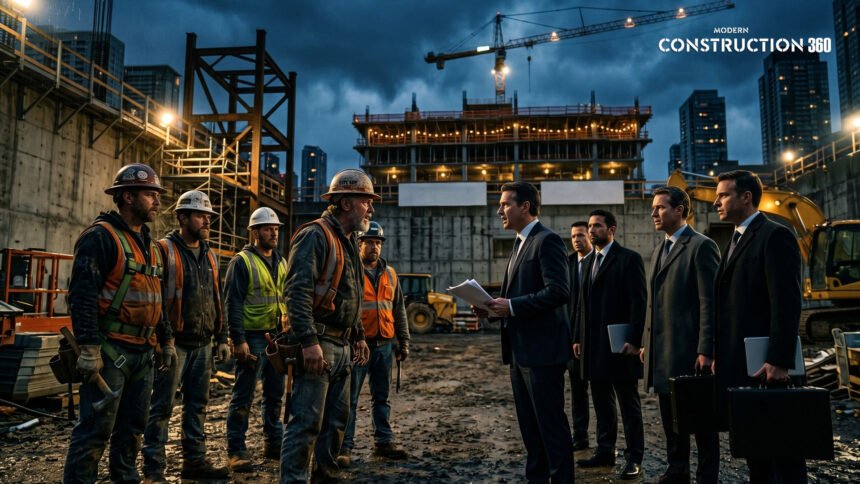
A developer has the land permitted, the contractor locked in, presales underway, and 30% equity already in the deal. He walks into a bank expecting a handshake. Instead, he gets a waiting room, two months of underwriting theater, and a loan-to-cost ratio so conservative it blows the pro forma to pieces.
The bank doesn’t say no. Banks rarely say no outright. They just add one more condition. Then another. Until the builder walks away, and the bank tells its regulators, “We made an offer. They declined.”
This is the builders vs banks construction lending standoff playing out quietly across the country, and it’s costing the housing market more than most people realize.
Why Banks Keep Saying No to Builders
Banks don’t hate builders personally. They hate uncertainty. And construction loans are uncertainty wrapped in concrete.
Here’s the short answer that matters: construction lending is fundamentally different from a standard mortgage. Instead of one lump-sum disbursement against a finished asset, a construction loan releases funds in draws as work progresses against an asset that doesn’t fully exist yet. That means the bank’s collateral is incomplete for months, sometimes years. Cost overruns can bloat budgets. Subcontractors can walk off a job over a payment dispute. And the bank, sitting at a desk reviewing paperwork, often has no idea any of it is happening until it’s too late.
The Progress Billing Problem
One banker put it plainly: unless a lender is making direct calls to the general contractor and tracking disputes in real time, progress billings, the bank’s primary collateral may not convert to cash as expected. And if there’s one thing you can reliably count on banks to dislike, it’s things not going as expected.
That lack of operational visibility has pushed most lenders to apply one blunt remedy: tighter terms. More equity is required upfront. Lower loan-to-cost ceilings. Higher rates. Personal guarantees. And, for newer developers without a long track record at that institution, no deal at all.
The Numbers Behind the Builders vs Banks Construction Lending Standoff
The data tells a story that builders already know by feel.
According to NAHB’s quarterly AD&C Financing Survey, builders and developers reported fifteen consecutive quarters of tightening credit conditions through Q3 2025, a trend confirmed by the Federal Reserve’s own senior loan officer survey, which tracked the same pattern in parallel. That’s nearly four straight years of the lending environment getting harder, not easier.
Fifteen Consecutive Quarters. And Counting.

In Q3 2025, the most common way lenders tightened was by lowering the maximum allowable loan-to-value or loan-to-cost ratio, cited by 60% of builders and developers surveyed. Reducing the amount they were willing to lend, requiring out-of-pocket interest payments, and demanding personal guarantees each tied for second, cited by 47%.
On rates: commercial construction loans in 2025 typically range from 6.8% to 13.8% for one-to-three-year terms, while residential construction financing generally sits between 6.25% and 9.75% APR, a significant jump from the 3–5% range developers relied on during the pandemic-era building boom.
The broader credit picture reinforces how structural this shift is. Banks account for roughly 60% of all construction financing activity, yet their share of commercial real estate loan originations fell from 58.3% in Q4 2022 to 39.5% in Q4 2023. Construction lending has suffered more from this banking sector dislocation than almost any other segment, and unlike fixed-rate acquisition loans, it has seen far fewer alternative sources of liquidity step in to fill the gap. Voya
What Happens When a Builder Can’t Get a Loan?

The ripple effect moves fast.
Some banks never intend to fund the loan at all; they string builders along for weeks, piling on conditions until the deal becomes impossible, then protect their turn-down ratio by claiming the builder walked away from a valid offer. It sounds unthinkable. It’s happening every day. Meanwhile, the builder has already spent money on permits, engineering, and contractor deposits that won’t come back.
And when enough builders hit that wall simultaneously, fewer homes get built. Ric Campo, CEO of Houston-based REIT Camden, projected a 60% reduction in multifamily starts as a direct result of banking pullbacks, noting that regional banks and large money-center banks ended up holding far more construction loans than they had planned for, leaving them unwilling, not just unable, to write new ones.
According to Zillow, U.S. home values have climbed 45.3% since February 2020, more than a decade’s worth of typical growth packed into just five years. A meaningful share of that appreciation traces directly to supply constraints. When the credit tap closes, the inventory pipeline dries up, and prices keep climbing for buyers who had nothing to do with any of it. Zillow
What Is Private Credit Doing in Construction Lending?
Filling in. Fast.
The private credit market stood at approximately $1.5 trillion at the start of 2024, up from roughly $1 trillion in 2020, and is projected to reach $2.8 trillion by 2028, a surge driven by tighter bank lending and the speed and flexibility that private credit can offer borrowers that traditional lenders increasingly cannot. Morgan Stanley
The largest alternative asset managers have moved aggressively into this space. Apollo Global Management had approximately $785 billion in assets under management as of Q1 2025, KKR was managing $638 billion at the end of 2024, and Blackstone had surpassed $1.1 trillion in AUM by Q1 2025, all three expanding their construction and real estate credit capabilities as bank lending retrenches.
But private capital isn’t cheap. And it’s not accessible to everyone. Smaller developers, the ones building workforce housing, infill projects, and entry-level homes in secondary markets, often can’t qualify for private credit on terms that make the numbers work.
How Builders Are Fighting Back

The smartest builders aren’t waiting for banks to come around. They’re restructuring how they capitalize projects entirely.
One telling example: a Florida developer had a mixed-use project fully permitted, with a signed guaranteed maximum price contract and 30% presales already secured, and traditional banks would only offer 60% loan-to-cost. The solution was a bifurcated capital stack combining senior bank debt with preferred equity from a private family office familiar with the local submarket.
That kind of creative structuring, layering mezzanine debt, preferred equity, and non-bank senior lenders, is becoming less of a last resort and more of a first call. Builders willing to accept lower leverage with some recourse can still access bank pricing around 200–250 basis points over SOFR; those needing higher-leverage, non-recourse structures are increasingly landing with debt funds instead.
Who Really Pays for This War?
Not the banks. Their capital is protected by the very tightening that stalls projects.
Not the big developers either, they have relationships, track records, and balance sheets sturdy enough to access private credit or co-invest with institutional partners.
The people paying are the ones trying to buy a home in a market where the inventory never arrives. The workforce family was priced out of an apartment that didn’t get built. The first-time buyer bidding against six others on a house that should have had three competitors if construction had kept pace.
Builders vs banks in the construction lending arena isn’t a Wall Street story. It’s a Main Street one. The fight happens in boardrooms and credit committees, but the casualty shows up on every listing sheet in every market where supply can’t keep up with demand.
The question isn’t whether banks will loosen up entirely. NAHB’s Q4 2025 AD&C survey showed the cost of credit for residential construction reached its lowest point since the rate-hiking cycle began in 2022, a narrow sliver of relief. But with nearly four years of tightening baked into the system, and private credit filling only part of the gap, the builders vs banks construction lending standoff isn’t ending soon.
It’s just getting more expensive to lose.