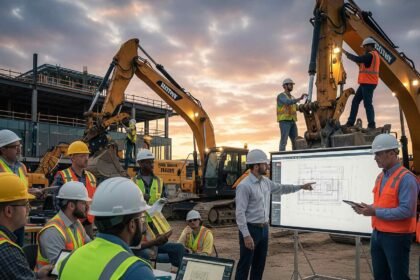
Every day, thousands of construction workers raise steel, pour concrete, and shape the infrastructure that powers our modern economy. Yet, behind the awe-inspiring physical progress of multi-million-dollar job sites lies an archaic, invisible bottleneck. While high-tech innovations optimize the front lines of construction, the back-office operations of these multi-million dollar projects remain trapped in a labyrinth of paper timecards, disconnected spreadsheets, and rigid software from the 1990s. When billions of dollars are spent building critical infrastructure, data centers, and housing, a single error in calculating complex labor rules can devastate a contractor’s profitability. The problem is not a lack of effort on the jobsite; it is an administrative crisis that stalls progress and drains margins before the concrete even cures.
The Fragmented World of Contractor Back-Offices
The construction industry faces some of the most complex workforce logistics of any sector in the global market. Unlike a typical corporate office, where employees work fixed hours at a single location, a single construction worker might move across multiple job sites, handle different tasks with separate cost codes, and be subject to entirely different pay scales within a single week.
Furthermore, the compliance requirements are staggering. Contractors executing public sector projects must navigate rigid prevailing wage rules, including federal Davis-Bacon requirements and state-specific regulations. They are legally mandated to generate intricate certified payroll reports, calculate complex union fringe benefits, track custom overtime rules, and manage multi-state tax variations.
Historically, contractors have been forced to choose between two deeply flawed software options. On one side stand massive, generic Human Capital Management (HCM) systems like ADP or Workday. While these platforms are powerful, they are completely blind to the nuances of construction-specific workflows and job costing. On the other side sit traditional construction Enterprise Resource Planning (ERP) tools. These legacy accounting systems process job costs reasonably well, but they offer completely inadequate, non-intuitive HR and employee benefits modules. As a result, office administrators find themselves trapped in a cycle of endless manual exports, formula errors, and administrative stress.
A Founder Who Embraced the Manual Grind
Enter Connor Watumull, the Co-Founder and CEO of Miter. Watumull’s path to disrupting construction tech did not follow the typical, hyper-polished Silicon Valley trajectory. Armed with an economics degree, he spent his early career navigating a diverse array of professional environments, operating as a consultant and later working in an investment role. Yet Watumull knew his long-term professional calling lay in software development. He was deeply fascinated by emerging advancements in embedded payments and financial automation, and he sought a meaningful, “decades-long problem” to solve.
Rather than assuming he understood the construction sector from the comfort of an investment office, Watumull took an unusually hands-on, radical approach to market research: he took an internship at a boutique bookkeeping and accounting firm that serviced construction contractors. He wanted to experience the pain points firsthand.
The strategy worked perfectly, though not without irony. Watumull frequently jokes that he was eventually fired from the bookkeeping gig because he simply was not a great manual accountant. However, his brief stint on the front lines of back-office administration provided the absolute conviction he needed. Within days of tracking credit card statements line by line and attempting to manually calculate prevailing wage data, Watumull realized that construction’s back-office problems were deeply systemic and structural, and entirely unaddressed by modern technology.
Restoring the Lost Superpower of Speed
Watumull’s personal motivation stems from a profound philosophical belief: the physical world matters, and society’s foundational ability to build efficiently has somehow stalled. Historically, massive infrastructure feats were achieved with stunning speed. The Empire State Building was built in just 410 days; the Pentagon was completed in a mere 16 months; and the Hoover Dam took only five years.
Today, adding a localized bike lane or repairing a public bridge can get tangled in bureaucratic and administrative tape for a decade. Watumull views this shift as a lost societal superpower.
Historical Construction Timelines vs. Modern Reality
Empire State Building (1931) : 410 Days
The Pentagon (1943) : 16 Months
Modern City Bike Lane (2020s) : Up to 5-10 Years (Due to administrative friction)
By founding Miter, Watumull set out to eliminate the friction that discourages tens of thousands of hardworking contractors. He realized that if a business owner is constantly stressed about compliance audits, bleeding money on inaccurate labor tracking, or fighting with payroll spreadsheets, they cannot focus on building safely and competitively. For Watumull, designing software isn’t just about lines of code; it is an active mission to restore productivity, eliminate administrative stagnation, and empower the people who build the physical world.
Attacking the Hardest Problem First
In the software industry, conventional startup wisdom dictates that you should build a Minimum Viable Product (MVP) around an easy, lightweight feature to find quick traction. Watumull and his co-founders threw out that playbook entirely. They chose to build their initial product around payroll, the most complex, high-risk, and heavily regulated component of construction administration.
The Miter engineering team focused 100% of its energy on tailoring the user interface to the unique operational realities of the construction workforce. Miter was intentionally designed to bridge the chasm between time tracking, payroll, and project accounting. The software functions as a comprehensive, cloud-based workforce management platform that unifies field operations with back-office HR. Field crews use a streamlined mobile application or a localized jobsite kiosk to clock in, upload equipment logs, track material quantities, and submit project photos. Supervisors can instantly review and approve digital timesheets on-site from a tablet.
Most importantly, that time data flows instantly and directly into the core payroll engine, automatically applying the correct base pay, overtime rules, and complex union or prevailing wage fringe benefits without a single manual calculation.
Scaling Through the Startup Trenches
Building a vertical SaaS business for a traditionally tech-skeptic industry presented substantial hurdles. The construction sector is notorious for its resistance to sudden operational changes. Field workers and foremen frequently push back against complex digital tools that disrupt their on-site, focused daily routines.
Miter overcame this cultural barrier by prioritizing extreme simplicity in their mobile interface. They designed field tools that feel intuitive rather than corporate, completely neutralizing the friction of digital adoption.
Growth accelerated rapidly as contractors experienced the immense financial clarity provided by the platform. Supported by a $23 million funding round backed by premier firms like Bessemer Venture Partners and Coatue Management, over 700 construction and field service contractors utilize Miter to manage their organizations. The platform securely processes billions of dollars in annual payroll wages, helping growing teams move completely away from error-prone paper systems and saving clients up to 40 hours per week on payroll operations alone.
Total Transparency to the Penny
Watumull’s vision for the industry is anchored in real-time operational truth. In modern construction, labor is almost always a contractor’s largest financial variable and greatest potential money leak. If a business owner cannot accurately calculate their fully-burdened labor costs, which include base pay, workers’ compensation insurance, payroll taxes, and union benefits, for weeks after a project closes, they are essentially managing in the dark.
Miter delivers exact, real-time job costing by connecting every hour of work directly to its designated project cost code and cost type. The platform’s open REST API enables bidirectional data synchronization with industry-standard ERPs and project management systems, including Sage 100, Sage 300, Sage Intacct, Procore, Autodesk Construction Cloud, and QuickBooks. This deep level of automation empowers business owners to bid on lucrative public sector contracts with total confidence, knowing that compliant federal WH-347 reports and state-specific certified payroll documentation can be exported with a few clicks.
High-Tech Software, White-Glove Support
Watumull’s leadership style centers on humility, direct operational experience, and a deep respect for the end user. He does not believe in managing from an ivory tower. Instead, he fosters a company culture that emphasizes deeply understanding the customer’s day-to-day struggles.
This philosophy is clearly reflected in Miter’s customer service model. Recognizing that a payroll glitch can disrupt a worker’s livelihood, Miter provides a premium, US-based implementation and support network. They offer high-touch, white-glove onboarding to ensure a smooth transition for new clients, backing up their sophisticated tech stack with fast, human-to-human communication via phone, email, or in-app chat.
The Foundation for a Productive Future
The future of construction is undergoing a massive generational shift. A new wave of technology-minded professionals is stepping into leadership roles across the industry, eager to replace outdated legacy systems with unified, modern software stacks. Under Watumull’s guidance, Miter is consistently expanding its capabilities far beyond its core payroll foundation.
The platform has grown into an all-encompassing suite that handles applicant tracking systems (ATS), learning management modules for safety certifications, automated corporate expense tracking, and intelligent field scheduling. By seamlessly connecting people, payments, and projects under a single cloud ecosystem, Watumull and Miter are not just modernizing the back office; they are actively building the digital framework that allows the physical world to grow faster, smarter, and with absolute confidence.
The Tech Stack Upgrade Contractors Need With Connor Watumull
This video is highly relevant because it features an in-depth conversation with Connor Watumull, who explains exactly how Miter links direct field tracking to automated, burdened payroll calculations to plug hidden contractor money leaks.