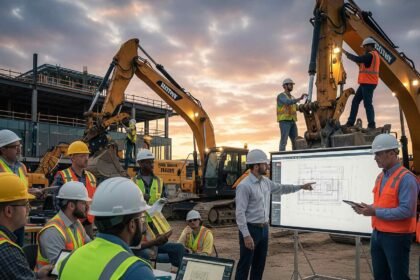
A massive, multi-family apartment block built in the mid-1960s sits on a quiet street in Germany. Its plaster is cracking, its basement is cold, and its fossil-fueled heating system chugs around the clock. The building is leaking heat into the atmosphere like a sieve, draining the wallets of its tenants and pushing the planet closer to a catastrophic tipping point. For decades, updating a building like this meant months of noise, scaffolding, unpredictability, and massive capital expenditures.
Today, a radical transformation is occurring. Instead of a swarm of construction workers spending half a year manual-laboring on scaffolding, a highly automated fleet arrives. Digital scanners map the building down to the millimeter, creating a precise virtual twin. In a nearby factory, robotic arms assemble massive timber-frame facade panels, complete with pre-installed insulation, triple-glazed windows, ventilation systems, and utility lines. These giant panels are shipped to the site and wrapped around the existing building like a perfectly tailored winter coat. Within a matter of weeks, without a single tenant having to pack a bag or move out, the crumbling relic becomes an ultra-modern, net-zero energy powerhouse that generates more electricity than it consumes.
This is not a futurist’s dream; it is the reality of “serial renovation,” an industrial revolution currently modernizing one of the world’s most stubborn, carbon-heavy industries. At the center of this movement is a Berlin-based ClimateTech trailblazer designed to rescue the built environment from its own obsolescence. By treating aging real estate not as individual construction headaches but as standardizable products, this pioneering approach is showing the world that saving the planet doesn’t require tearing down the past; it requires wrapping it in the future.
The Trillion-Dollar Architectural Bottleneck
The global conversation around climate change frequently spotlights electric vehicles, solar farms, and wind turbines. Yet, one of the primary drivers of greenhouse gas emissions remains hidden in plain sight: the buildings where humanity lives, works, and sleeps. Globally, the built environment is responsible for a massive share of total energy consumption and carbon emissions. In Europe alone, approximately 75 percent of the existing building stock is classified as highly energy inefficient. Shockingly, over half of the continent’s 315 million residential units suffer from an energy performance rating of “E” or worse.
Historically, the construction sector has been notorious for low productivity growth, relying on the same craft-based, manual techniques used for generations. Traditional retrofitting is a logistical nightmare. It involves coordinating dozens of fragmented trades, plumbers, electricians, plasterers, and window installers on highly unpredictable physical sites. This leads to long project timelines, severe labor shortages, budget overruns, and immense disruption to residents.
Because of these friction points, Europe’s annual building renovation rate hovers below a dismal 1 percent. To achieve the strict carbon-neutral targets mandated by global climate agreements, that rate needs to triple immediately. Property owners face a compounding crisis: regulatory penalties for carbon-intensive real estate, falling property values for inefficient buildings, and skyrocketing energy bills for tenants. The market volume required to upgrade these underperforming homes is staggering, estimated at upwards of €6.2 trillion in the European Union alone. The problem is clear: the planet cannot build its way out of the climate crisis through new construction alone. To survive, humanity must find a scalable, affordable way to fix what already exists.
A Visionary at the Intersect of Climate and Industry
Enter Emanuel Heisenberg, the founder, CEO, and Managing Director of ecoworks. Heisenberg is not a typical construction executive. He is a seasoned climate tech pioneer, author, and policy advisor who has spent his career operating at the intersection of environmental sustainability, deep technology, and national regulation.
Before launching ecoworks in Berlin alongside co-founder Kristofer Fichtner, Heisenberg had already established an impressive track record as a serial entrepreneur. He previously launched and managed deep tech startups focused on deep geothermal energy and decentralized heating systems. His deep expertise in how energy flows through communities made him acutely aware of the massive inefficiencies embedded in legacy infrastructure.
Recognized globally for his impact, Heisenberg is a member of the prestigious Meaningful Business 100 (MB100) network, which celebrates leaders blending purpose and profit to advance the United Nations Sustainable Development Goals. Far from just managing a business, he actively shapes the broader economic landscape, serving as an advisor to the German government on heat and decentralized energy policies. Together with Chief Operating Officer Michael Vahrenkamp, Heisenberg’s multi-dimensional perspective allowed him to see the building crisis not just as a structural engineering challenge, but as a systemic supply-chain and regulatory problem waiting for an industrial solution.
The Power of Family Legacy and Personal Conviction
To understand Emanuel Heisenberg’s relentless drive to solve complex, systemic crises, one has to look no further than his family roots. He is the grandson of Werner Heisenberg, the Nobel Prize-winning physicist who famously formulated the uncertainty principle and fundamentally altered humanity’s understanding of quantum mechanics. Growing up in an environment where scientific rigor, systemic thinking, and pushing the boundaries of human knowledge were normalized, Emanuel developed a natural inclination toward solving grand challenges.
However, his personal motivation is anchored firmly in the pressing crises of the present. Heisenberg recognized early on that climate change is the defining macroeconomic and existential threat of the 21st century. He realized that incremental changes, like changing lightbulbs or installing smart thermostats, were entirely inadequate against a challenge of this scale.
He developed a deep frustration with the slow pace of carbon reduction in the heating and real estate sectors. He observed that while sectors like mobility and electricity generation were digitizing and modernizing at breakneck speed, the construction sector remained stuck in the past. This gap filled him with a strong sense of personal conviction: if the established construction giants were unwilling or unable to industrialize climate action, he would have to build a company capable of doing it for them.
Redefining Construction as an Automated Assembly Line
In 2019, Ecoworks was formally incorporated with a disruptive proposition: bring the automation, speed, and precision of automotive manufacturing to the fragmented world of real estate renovation. Under Heisenberg’s leadership, the company pioneered an end-to-end “360-degree serial renovation” model that fundamentally changes how modernizations are executed.
The ecoworks process is completely digital, moving through a highly coordinated series of steps:
- AI-Powered Portfolio Analysis: Property owners can submit a list of simple postal addresses. Using AI-driven image recognition and 3D satellite data, ecoworks evaluates the properties from above, clustering them into recurring architectural typologies to immediately identify which buildings are ideal candidates for serial upgrades.
- The Digital Twin: Once a project moves forward, precision laser scanning captures the building’s exact physical dimensions down to the millimeter. This data is converted into a 3D digital twin, a perfect virtual replica used to plan every aspect of the engineering phase.
- Automated Factory Production: Instead of building components by hand on-site, up to 80 percent of the labor is shifted to a controlled factory environment. Using advanced automation and robotic systems, timber-frame facade and roof elements are prefabricated. These panels come completely equipped with sustainable insulation, pre-fitted windows, solar panels, and integrated ventilation.
- Rapid On-Site Installation: The ready-to-assemble modules are transported directly to the site. The in-house installation team fastens the panels directly onto the old facade in a matter of weeks, minimizing tenant disruption and bypassing traditional construction delays entirely.
By transforming a building into a “plus-energy” house that harvests its own power via integrated solar arrays and modern heat pumps, ecoworks enables a truly climate-neutral building operation.
Overcoming Capital Constraints and Scaling Neighborhoods
Transforming a deeply entrenched, historically risk-averse industry is an uphill battle. In its early years, ecoworks had to navigate the skepticism of traditional real estate developers and construction firms who doubted that modular, factory-built skins could seamlessly fit onto old, warped buildings. Securing the massive amounts of capital required to develop proprietary 3D planning software and fund factory infrastructure was a significant hurdle.
However, Heisenberg’s strategic execution rapidly turned skeptics into investors. The company closed a massive €40 million funding round led by World Fund, Europe’s leading climate-focused venture capital firm, alongside prominent investors like Haniel, KOMPAS VC, and ISAI. This round was nearly three times oversubscribed, underscoring the massive market demand for scalable retrofitting technology. By early 2026, the company’s total cumulative funding across all investment rounds reached an impressive $81.2 million.
This capital injection has fueled a massive leap in operational scale. Moving past isolated pilot projects, ecoworks is currently deploying Germany’s largest cooperative serial renovation to date in the city of Hagen. Backed by €23 million in project funding, ecoworks is modernizing an entire neighborhood consisting of twelve multi-family residential buildings, originally constructed in 1966, for the housing cooperative Wohnungsverein Hagen eG. The project will bring 192 apartments up to the strict KfW Efficiency House 55 standard, saving approximately 190 tonnes of carbon dioxide emissions annually. This massive project proves that the ecoworks model is highly effective at a neighborhood-wide scale.
Shifting Construction from Craft to Code
Emanuel Heisenberg’s industry expertise lies in his unique capability to view physical buildings through the lens of digital software. He frequently argues that the ultimate solution to the construction industry’s labor shortages and high costs is data standardization. By curating a digital catalog of over 300 standardized, pre-engineered building components, ecoworks can easily mix and match parts to fit a vast majority of mid-century European apartment styles.
Heisenberg’s vision extends far beyond typical real estate optimization; it is anchored directly in global decarbonization. His stated corporate goal is for ecoworks to save a cumulative one gigaton of greenhouse gas emissions by the year 2045. To achieve this, he actively positions ecoworks as a key player in the European “renovation wave,” aligning the company’s growth with strict new EU environmental compliance laws. Under his guidance, ecoworks does not just function as a general contractor; it operates as an open-ended digital platform capable of driving an ecosystem of manufacturing partners, green technology suppliers, and institutional property owners toward a shared zero-emission goal.
Empowering Teams with Transparency and Scientific Rigor
As a leader, Emanuel Heisenberg practices a style that combines deep purpose-driven passion with data-driven transparency. He fosters a highly cross-functional corporate culture in Berlin, deliberately blending software engineers, data scientists, and robotics experts with veteran construction managers and procurement specialists. Bridging the cultural gap between tech startups and traditional blue-collar construction requires a leadership style built on mutual respect and a shared mission.
Heisenberg leads by encouraging rigorous experimentation. Because solving the climate crisis requires rapid innovation, he empowers his teams to iterate quickly on software code, digital imaging algorithms, and mechanical designs. He values direct communication and clear milestones, attributes that have allowed ecoworks to scale its workforce to over 200 employees while maintaining high capital efficiency and improving project profit margins.
Blueprint for a Carbon-Neutral Continent
The future outlook for ecoworks under Emanuel Heisenberg is incredibly bright. As governments across the globe tighten carbon taxes and penalize energy-inefficient buildings, the financial pressure on real estate owners to modernize will continue to grow exponentially. The successful execution of neighborhood-scale rollouts like the Hagen project provides ecoworks with a proven blueprint to expand its operations out of Germany and into broader European markets like France, the Netherlands, and the United Kingdom.
Ultimately, Emanuel Heisenberg and ecoworks are proving that the built environment does not have to be an obstacle to a sustainable future. Through the clever application of AI planning, robotic automation, and prefabricated modular architecture, they are transforming millions of outdated properties into vital assets for a clean-energy economy. By successfully decoupling construction from slow, manual processes, Heisenberg is leading a profound industrial transformation, one that is successfully rebuilding the world from the inside out, one factory-built panel at a time.