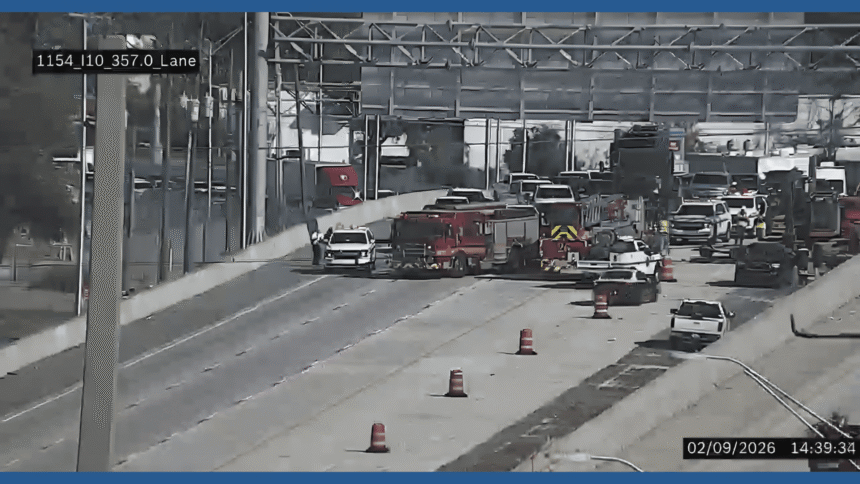
A 30-year-old woman died Monday afternoon after her vehicle collided with a parked construction excavator on Interstate 10 West near Lane Avenue, according to the Florida Highway Patrol (FHP).
The crash happened at about 2:15 p.m. when the woman, whose name has not been released, was driving westbound on I-10 and tried to merge into the right lane. Troopers said she lost control of her sedan, which veered toward the left shoulder, where a heavy excavator was parked as part of ongoing construction work.
The car struck the excavator with a high-impact collision. Emergency crews responded quickly, but the woman was pronounced dead at the scene.
The fatal collision forced authorities to close all westbound lanes of I-10 between Lane and Cassatt avenues for hours. Traffic backups stretched to Roosevelt Boulevard as investigators processed the scene and cleared debris.
Crash Details and FHP Findings
According to FHP, the woman’s sedan was westbound on I-10 when she attempted to merge into slower traffic on the right. She lost control, crossed left toward the shoulder, and struck the parked excavator used in a nearby construction zone.
At the time of the collision, troopers said the excavator was stationary on the shoulder to support widening and repair work along the interstate. No construction workers were reported injured in the incident.
An FHP spokesperson noted that the woman was not wearing a seatbelt, but authorities have not yet confirmed whether that contributed to her fatal injuries. The investigation remains active, and troopers are reviewing evidence to determine if speed, distraction, or roadway conditions were factors.
Construction Zone Safety and Move-Over Law
The I-10 corridor through Jacksonville has been the focus of widening and improvement projects, which require periodic lane closures and staging of heavy equipment near travel lanes.
Florida’s Move Over law mandates that drivers either move over a lane or slow down when approaching stopped emergency or maintenance vehicles to protect roadside workers and prevent secondary crashes. Law enforcement officials have repeatedly emphasized this rule in recent public safety campaigns.
Traffic safety advocates say this crash underscores a persistent problem: drivers fail to reduce speed or exercise caution when approaching construction zones. With heavy equipment parked close to active lanes, the margin for error is razor-thin. Local FDOT advisories often urge motorists to expect delays and exercise caution in these areas.
Aftermath and Community Impact
The closure of the westbound I-10 for several hours disrupted afternoon commutes, with drivers rerouted and significant delays reported. Roadway reopening was gradual as crews worked to tow the damaged vehicle and clear the excavator site.
The woman’s death marked the latest in a troubling trend of fatal crashes on Florida interstates involving stationary objects, from parked tractors and construction machinery to stalled vehicles on shoulders. While statistics vary by year, FHP data often show that loss of control in merging situations is a common factor in fatal roadside collisions. (Multiple FHP crash summaries from recent years indicate similar patterns of loss of control leading to stationary impacts.)
Traffic experts caution that infrastructure improvements must be matched with stronger driver education and enforcement. Simply posting signs and advisories isn’t enough; drivers must adopt consistent defensive techniques, especially in high-speed, high-construction areas.
Opinion: A Preventable Tragedy
This crash could easily qualify as a preventable fatality. Construction along major interstates like I-10 is a long-term reality, not a temporary nuisance. That means drivers should anticipate narrow shoulders, heavy machinery, and abrupt lane shifts as standard conditions, not occasional hazards.
When merging lanes, tightening, and when vehicles try to accelerate or decelerate rapidly, situational awareness is critical. Defensive driving, including consistently wearing a seatbelt, maintaining safe speeds, and proactively scanning the road ahead, isn’t optional, it’s survival.
Moving forward, officials and roadway safety advocates agree that stronger public education and enforcement of move-over and speed-zone laws can reduce similar tragedies. Every parked piece of equipment on a highway carries inherent risk, and it’s on drivers to acknowledge that risk before it’s too late.
Image Credit: FL511