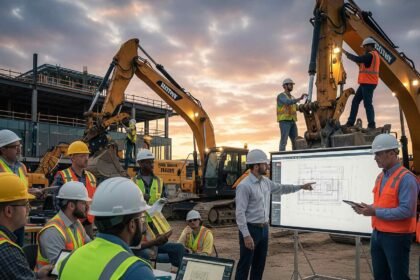
For over a quarter of a century, the fundamental way we design and engineer buildings has remained stubbornly unchanged. Architects sketch bold visions of futuristic, sustainable skyscrapers, corporate hubs, and massive data centers, but translating those visions into functional reality requires an agonizing, invisible step. Deep within the blueprint phase lies a massive bottleneck: Mechanical, Electrical, and Plumbing (MEP) engineering. This discipline acts as the nervous system, respiratory tract, and circulatory infrastructure of any physical structure.
While other sectors embraced automation, cloud workflows, and predictive software, MEP engineering remained trapped in highly manual, repetitive legacy processes. Teams of highly specialized consultants spend months placing light switches, tracing conduit paths, and manually calculating cable lengths.
Now, a seismic shift is occurring from Stockholm, Sweden. Endra, an artificial intelligence company focused on construction technology, has introduced a platform capable of compressing two months of tedious manual layout work into less than 24 hours. By replacing legacy software routines with generative AI, deterministic algorithms, and advanced computational geometry, Endra is fundamentally rewriting the timeline of global construction.
The Hidden Bottleneck in the Built World
The global construction industry is confronting a massive mismatch between supply and demand. Driven by rapid urbanization, aggressive green energy transitions, and an unprecedented boom in data center construction, the built-environment sector is under intense pressure to expand its delivery capacity. Estimates suggest that global construction output must increase by more than 40 percent by 2030, and nearly 70 percent by 2040, to keep pace with global economic development. According to the International Energy Agency, the total floor area of global buildings will expand by a staggering 75 percent by the year 2050.
Concurrently, the climate crisis demands that the industry move backward and forward simultaneously. Approximately 20 percent of existing buildings must be heavily retrofitted by 2030 to comply with strict zero-carbon standards. Furthermore, the global housing deficit requires the construction of roughly 21 million new homes annually. The rise of generative AI itself has sparked an explosive demand for high-density digital infrastructure, with data center capacity expected to more than triple over the current decade.
Yet, as the physical demand for construction skyrockets, the technical workforce required to design these structures is shrinking. The global construction industry suffers from a severe, structural shortage of skilled engineers. Young professional talent is increasingly drawn to pure-play software development rather than building systems engineering. This leaves engineering consultancies short-staffed and overwhelmed.
Historically, when an architect hands over a 3D model of a building, MEP engineers must manually figure out where to place thousands of devices, smoke detectors, electrical sockets, ventilation ducts, and then manually route miles of conduits and pipes through tight ceilings without causing structural overlapping or “clashes.” Because building codes vary radically by city, state, and country, this process has traditionally required multiple human review loops and months of slow, iterative labor. It is a slow, error-prone phase that delays projects long before ground is broken.
The Entrepreneur Behind the Automation
Recognizing this critical vulnerability required an entrepreneurial perspective that combined software systems architecture with a deep understanding of technical infrastructure. Enter Niklas Lindgren, Co-founder and CEO of Endra. Lindgren is a serial technology entrepreneur with a distinguished track record of building, scaling, and successfully exiting companies centered on complex technical infrastructure, cybersecurity, and enterprise systems.
Rather than coming from a traditional, insular construction background, Lindgren approached the industry’s productivity stagnation as a pure system optimization problem. He recognized that MEP engineering was essentially a highly complex spatial and regulatory puzzle, one that was perfectly suited for a hybrid software architecture combining artificial intelligence with strict physical constraints.
To execute this ambitious vision, Lindgren assembled a premier founding team in Stockholm. He paired up with Co-founder and Chief Operating Officer Anton Juric, a fellow entrepreneur with a shared history of scaling infrastructure companies. To build the deep-tech backbone of the platform, they brought on technical co-founders David Rydberg and Gustav Hammarlund. Both Rydberg and Hammarlund are elite systems engineers who previously built and maintained the highly complex, low-latency critical infrastructure powering Goldman Sachs’ equity trading platforms across Europe, the Middle East, and Africa. Together, this leadership group applied the rigorous precision of high-frequency financial engineering to the messy, real-world challenges of physical construction.
A Mission to Liberate Human Engineers
Lindgren’s motivation to build Endra was rooted in both personal observation and a clear-eyed realization that human intellect was being misallocated. The initial spark came from his father, an architect, who described how painfully manual, outdated, and unautomated the design and routing phase for core building utilities remained, despite decades of advancement in pure architectural drafting software.
Lindgren realized that highly trained, intelligent engineers were burning out because they were trapped performing these low-value, repetitive tasks. When a young professional graduates with an advanced engineering degree, they expect to spend their career solving complex thermodynamics problems, optimizing energy grids, and designing sustainable water systems. Instead, the reality of entry-level MEP engineering involves sitting in front of a computer screen for ten hours a day, manually clicking and placing thousands of electrical outlets and smoke alarms across hundreds of identical hotel rooms or office floors.
By delegating the repetitive, rule-based layout and routing tasks to an intelligent software agent, Endra elevates the role of the human engineer from a manual drafting technician to a high-level systems reviewer. This shift not only accelerates building delivery but also restores intellectual dignity to the engineering profession, enabling design-and-build firms to focus on core sustainability, architectural harmony, and cost-efficiency.
Engineering the Generative Blueprint
Endra was incorporated in Stockholm, Sweden, in late 2024 and officially emerged from stealth mode in May 2025, positioning itself as a vertical Software-as-a-Service (SaaS) provider purpose-built for modern construction ecosystems. From its inception, Lindgren and his team refused to build just another superficial plug-in or basic visual overlay. They aimed to create a core digital infrastructure that could integrate directly with industry-standard platforms like Autodesk Revit.
The engineering magic of Endra lies in its sophisticated hybrid system architecture. The platform does not rely solely on Large Language Models (LLMs), which are prone to hallucinations and struggle with exact spatial arithmetic. Instead, Endra combines the contextual intelligence of LLMs with proprietary 3D simulation engines and strict, deterministic mathematical algorithms.
When an engineering firm imports an architect’s 3D model or a dense set of text-heavy tender documents into Endra, the platform’s LLM sub-systems go to work. They read, parse, and interpret the architect’s intent, automatically pulling out key design parameters, lighting standards, and regulatory requirements specific to the local municipality.
Once these parameters are established, Endra’s deterministic geometry engine takes over. The engine automatically generates code-compliant layouts for lighting, power distribution, fire safety systems, cabling, and ventilation. Because it operates on exact physical and mathematical rules, the software ensures that a water pipe never accidentally cuts through an electrical conduit or a structural beam, creating completely “clash-free” models.
Beyond generating the 3D visual space, Endra automatically compiles the massive mountains of mandatory compliance documentation. With a single click, it produces fully detailed 2D schematics, structural drawings, engineering calculations, and material schedules ready for regulatory approval and on-site construction.
Hyper-Growth and Capital Influx
The market response to Endra’s generative platform was instantaneous, presenting the young company with unique scaling challenges. After onboarding its initial cohort of active pilot customers in August 2025, the raw efficiency gains shocked early participants. In live project deployments, Endra demonstrated productivity improvements exceeding a 70x multiple compared to traditional workflows. Designing the entire, comprehensive electrical framework for a massive commercial complex, a task that normally derailed an engineering team for eight full weeks, was wrapped up in less than 24 hours.
Word of these metrics spread rapidly through the global construction community. By late 2025, Endra’s waitlist swelled to over 600 major engineering and construction enterprises spanning 90 countries. The demand grew so rapidly that Lindgren and COO Anton Juric made the strategic decision to intentionally cap their early pilots, limiting access to a select group of partners to ensure product stability before a broader global rollout.
To fuel its rapid infrastructure expansion and satisfy this global backlog, Endra executed a highly successful fundraising trajectory. Following a €3 million pre-seed round (roughly $3.4 million) in May 2025, Endra closed a massive $20 million Seed funding round in December 2025. This round was led by the prominent London-based venture capital firm Notion Capital, with continued backing from Stockholm’s Norrsken VC, bringing the company’s total capital raised to an impressive $23.4 million USD.
The successful capital raise underscored the venture community’s deep conviction in Endra’s market opportunity. As Alexander Danielsson, a partner at Norrsken VC, noted, doubling down on Endra just six months after leading their pre-seed was an easy decision, given the exceptional market demand and the team’s unprecedented speed in bringing archaic, 2D-bound workflows into an automated 3D environment.
Navigating the Future of Constructive Intelligence
Niklas Lindgren’s industry vision is deeply tied to the economic transformation of the built environment. He regularly highlights that the construction sector is moving away from traditional time-and-materials billing toward outcome-based pricing models. Under old business models, engineering firms billed clients by the hour, which unintentionally incentivized slow, manual labor. In an outcome-based market, clients pay for the speed, accuracy, and quality of the final design, directly rewarding firms that can deliver flawless, compliant blueprints instantly.
Furthermore, Lindgren views Endra as an essential tool for managing the complex geographical realities of modern engineering. Today, many Western engineering consultancies rely heavily on outsourced design units located in different time zones to handle manual drafting. This distributed model often introduces severe communication gaps, coordination errors, and regulatory discrepancies. By deploying Endra as a centralized digital infrastructure, leadership teams can handle localized compliance and design generation instantly in-house, eliminating outsourcing friction entirely.
Empowering Teams Through Flat Autonomy
To maintain the rapid product development required to revolutionize a global industry, Lindgren has cultivated a highly focused, mission-driven corporate culture at Endra’s headquarters in the Östermalm district of Stockholm. Drawing on his extensive experience in technical software enterprises, Lindgren champions a leadership style rooted in high autonomy, flat organizational structures, and rigorous technical execution.
Lindgren rejects the bloated management layers common in legacy construction corporations. Instead, he structures Endra around cross-functional hubs where AI researchers, computational geometry specialists, and seasoned construction domain experts sit side by side.
By empowering his engineering and product teams to make rapid decisions without navigating bureaucratic review chains, Endra matches the agility of a software enterprise while tackling the rigid, physical challenges of heavy industry. Lindgren’s leadership focuses on creating extreme clarity around the core mission: removing manual friction from the built world so that human creativity can build a sustainable future faster.
Designing the Global Skyline
With fresh capital and a valid product-market fit, Endra’s roadmap is focused on rapid international scale and multi-disciplinary expansion. The company is deploying its seed funding to aggressively expand its engineering and AI teams by 3x, while establishing permanent operational offices across its primary expansion markets: the United States, the United Kingdom, and Germany.
Technically, Lindgren is guiding the platform far beyond its initial focus on electrical, lighting, and fire safety systems. Endra is actively expanding its generative capabilities to incorporate full-scale Heating, Ventilation, and Air Conditioning (HVAC) and complex plumbing systems into its core engine. This expansion will allow the software to provide a truly unified, end-to-end generative MEP ecosystem.
A major step forward in this journey was realized through Endra’s strategic partnership with AFRY, a global engineering, design, and advisory giant. By collaborating deeply during Endra’s active development phase, the partnership allows the engineering titan to directly evaluate, stress-test, and shape the AI platform within real-world project constraints. It proves that AI-driven precision can drastically improve quality, speed, and sustainability metrics across massive infrastructure projects.
As the global building boom collides with strict climate targets and an unprecedented engineering labor shortage, the old way of drafting buildings by hand is no longer viable. Through Endra, Niklas Lindgren and his team are building more than just a powerful software platform; they are establishing the core digital architecture that will design and scale the global communities of tomorrow.