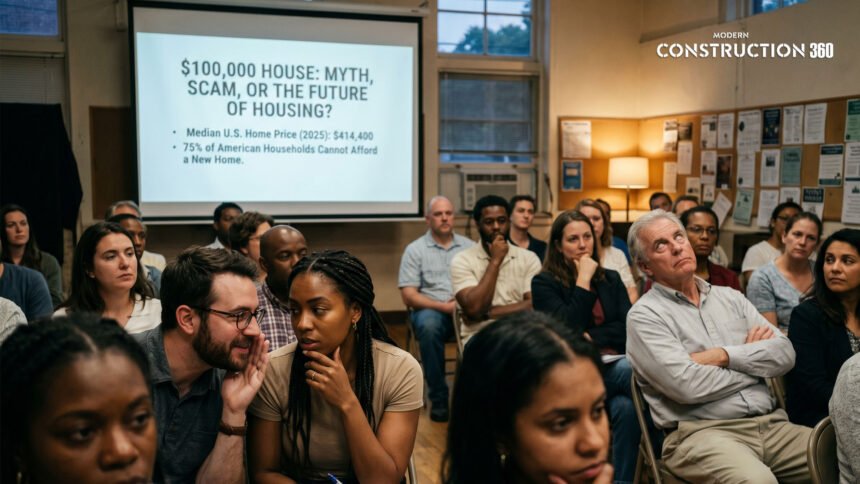
Let’s start with a number that’ll make your stomach drop: according to the National Association of Realtors, the full-year 2025 median U.S. home price settled at $414,400, and three-quarters of American households can’t afford the typical newly built home at current mortgage rates. For millions of families, that’s not a stretch goal. It’s impossible.
So when someone floats the idea of a $100,000 house, two things happen. Half the room rolls their eyes. The other half leans in.
Is it a scam? A pipe dream sold by influencers hawking rural land and “freedom lifestyle” content? Or is there something real underneath all the noise? The answer, like most things in housing, is complicated and a lot more interesting than a simple yes or no.
Can You Actually Build a $100,000 House in 2026?
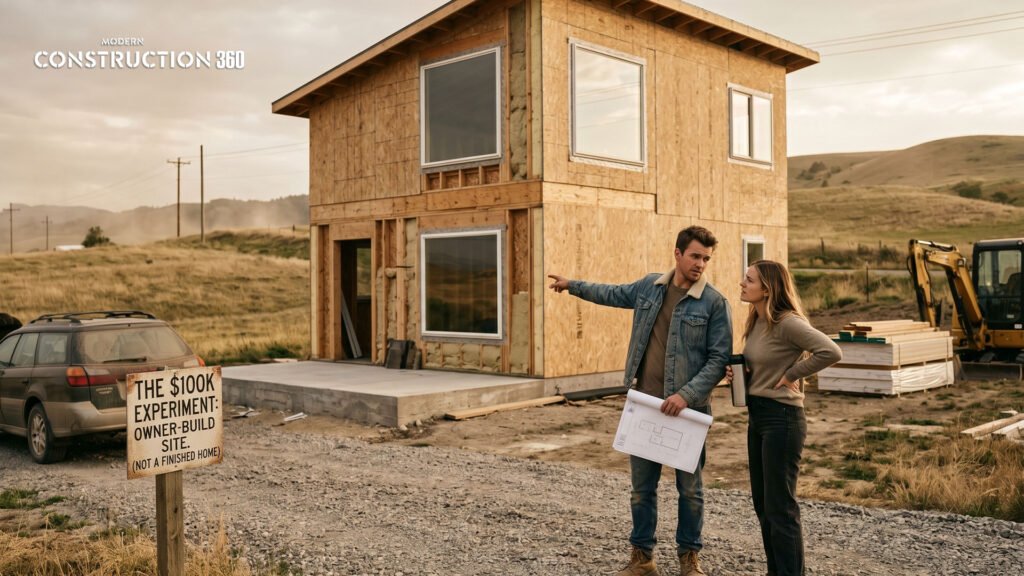
The short answer: yes, but the conditions that make it possible are specific, and most people don’t meet them.
A $100,000 house is achievable if you’re building small (think 500–1,000 square feet), you own cheap land in a low-cost region, you use prefabricated or alternative construction methods, and you’re willing to do some of the work yourself. Miss even two of those conditions, and you’re already over budget before the foundation is poured.
That said, “possible under the right circumstances” is very different from “a realistic option for most buyers.” And that distinction matters enormously.
The Real Numbers Behind the Housing Crisis
Here’s why the $100,000 house conversation has gotten so loud: because the alternative is increasingly out of reach for ordinary people.
According to NAHB’s 2025 affordability data, 76.4 million households, roughly 57% of all U.S. households, cannot afford a $300,000 home. Read that again. More than half the country can’t afford a home that costs $300K, and NAHB’s modeling puts the median price of a new single-family home at $459,826 in 2026.
That gap is not a rounding error. It’s a structural collapse.
Harvard’s Joint Center for Housing Studies confirmed that the national median home price reached five times the median household income in 2024, nearly matching previous record highs, and the ratio has held near that level into 2025. A generation ago, the rule of thumb was three times your annual salary. Today, that benchmark sounds like something out of a history book.
This is the crisis the $100,000 house is responding to. And when you frame it that way, the idea starts to feel less like a novelty and more like a necessity.
What Types of Homes Can Actually Hit the $100K Mark?
Not every housing type can get there. But some can, and some are getting surprisingly close.
3D-Printed Homes: The Headline vs. The Fine Print
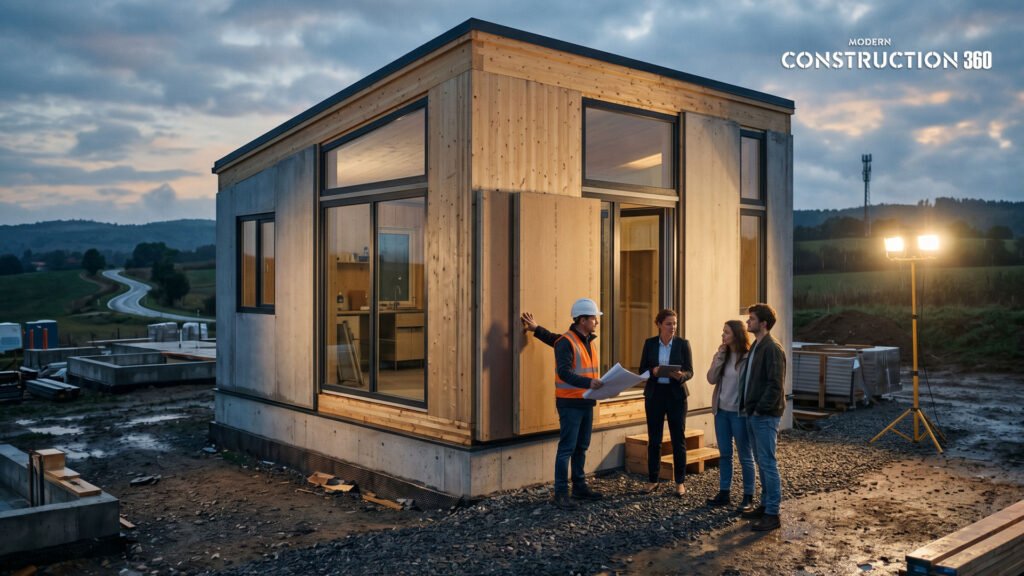
You’ve probably seen the headlines. Azure Printed Homes, based in Southern California, developed a 3D-printing process that produces homes at an advertised starting cost of approximately $35,000, constructed from recycled materials, including plastic water bottles and food containers. Impressive. Also, not the whole story.
Those eye-catching low prices refer only to the structural shell, the printed walls, which represent just 40–50% of the total cost of a livable home. Plumbing, electrical, roofing, insulation, and permits, all of that still have to be paid for the old-fashioned way. A complete 3D-printed home ready to move into generally costs between $150 and $275 per square foot in 2025, meaning a small home can run around $90,000, while larger custom builds easily exceed $600,000.
So yes, a compact 3D-printed home can land close to $100,000. But it requires keeping the footprint small, the design simple, and the location right.
Construction technology company ICON pushed the threshold further with its “Initiative 99” competition, which concluded in October 2024, challenging designers worldwide to create 3D-printed homes that could be built for under $99,000. Winners were selected from over 60 countries, and two professional-category designs were selected to be physically built at Community First! Village in Austin, Texas, is a master-planned nonprofit community serving the unhoused. That’s not hype. That’s a real engineering milestone that’s being put to the test in concrete and polymer.
Prefab, Modular, and Barndominiums
3D printing gets the headlines, but prefab and modular homes have been doing quiet, unglamorous work in affordable housing for decades.
Prefabricated and modular homes can cut costs by 20–30% compared to traditional construction. Barndominiums, metal-framed homes with open layouts, and shipping container homes also fall within striking distance of the $100K mark, particularly for smaller builds. None of these is glamorous. But they’re real, they’re permitted, and they’re livable.
Where in America Can You Still Pull This Off?
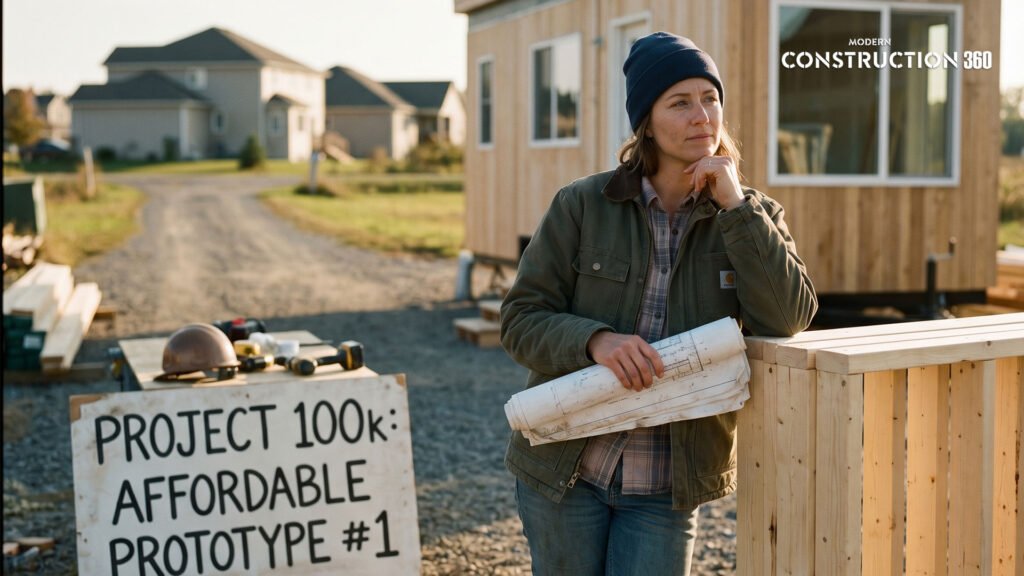
Location is the variable that makes or breaks the $100,000 house. And geography here is everything.
Rural land in Missouri still averages under $5,000 per acre in many areas, especially the southern Ozarks, and several counties have limited or no zoning regulations, making them attractive for tiny home dwellers and off-grid buyers. In Michigan’s Upper Peninsula, land prices drop as low as $500 per acre. In northern Maine, Aroostook County offers acreage often priced under $1,000 per acre.
If you can find land for $10,000–$20,000 and put up an 800-square-foot modular or prefab structure for $75,000–$85,000, you’re in the ballpark. It’s not comfortable city living. There may be no Whole Foods within 40 miles. But a $100,000 house that you own outright is a very different financial proposition than a $2,200/month mortgage you’ll be paying off for 30 years.
The states where this is most realistic right now, based on land cost, construction costs, and zoning flexibility, include Mississippi, Arkansas, Missouri, Michigan, and rural portions of Arizona and New Mexico. These aren’t glamorous markets. They’re functional ones.
Is the $100,000 House the Future of Housing, or Just a Fantasy?
Depends on what you mean by “future.”
If you mean: will $100,000 houses become the dominant form of new construction in American suburbs? No. The structural math, land costs, labor, permitting, and materials make that nearly impossible without massive policy intervention. The paradox is clear: the homes we call “affordable” are often still unaffordable, and homes that are truly affordable are virtually impossible to build without deep subsidies or public land.
But if you mean: will $100,000 houses play a growing, meaningful role in solving the housing crisis? Absolutely yes, and they already are.
The January 2026 LA wildfires destroyed more than 16,000 homes and structures across Los Angeles County, creating urgent, immediate demand for faster and more cost-effective rebuilding. Companies like Azure are shipping 3D-printed units in weeks. ICON’s Initiative 99 produced real winning designs now being built for real unhoused communities. Prefab manufacturers are scaling. And rural land, in states most coastal buyers overlook, is still attainable for under $10,000 an acre.
The $100,000 house isn’t a scam. It’s not a myth. It’s a real option for a specific kind of buyer, someone willing to downsize their footprint, expand their geographic range, and rethink what “home” actually needs to look like. For millions of Americans locked out of a market where the median new home price is pushing $460,000, that kind of rethinking might not just be practical.
It might be the only option left on the table.
The question isn’t whether the $100,000 house is real. The question is: are you willing to meet it where it actually exists?