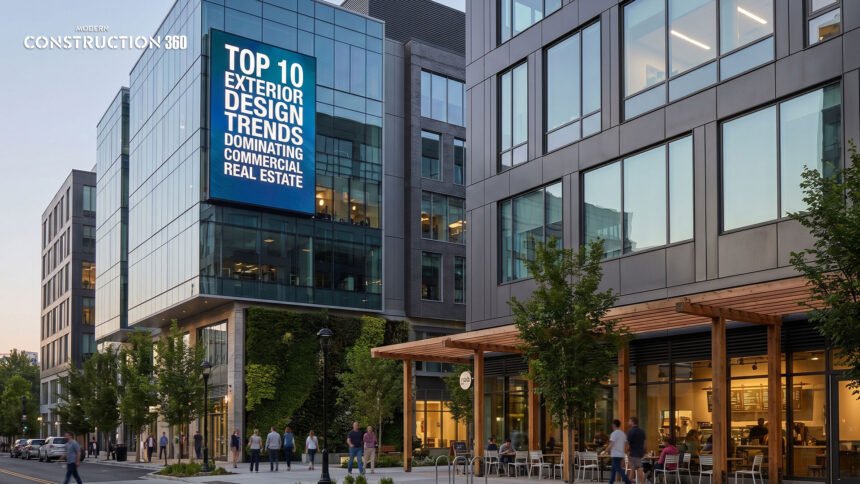
Picture this: a prospective tenant pulls up to two buildings on the same block. One is a flat glass box that looks like it was designed in 2003 and never revisited. The other has a textured mixed-material facade, cascading greenery, and a ground-level terrace that spills onto the sidewalk. The lease gets signed that afternoon, and it isn’t a close call.
Commercial real estate exterior design trends have become a decisive factor in tenant attraction, asset valuation, and long-term property performance. In 2025, buildings are no longer passive containers for business activity. They’re brand statements, environmental performers, and competitive tools, all at once. Whether you’re a developer, investor, or owner-occupier, knowing what’s reshaping commercial exteriors right now isn’t optional anymore.
Here’s what’s dominating the conversation.
What Is Driving Commercial Exterior Design in 2025?
Three converging forces are reshaping commercial building exteriors: sustainability mandates, tenant wellness expectations, and the flight to quality in a post-pandemic leasing market. As the national office vacancy rate held around 20.7% through mid-2025, owners realized that raw square footage no longer sells, but curb appeal, environmental credentials, and experiential design do. Developers who understood this early are already seeing the payoff in occupancy rates and rent premiums.
1. Biophilic Facades and Living Walls
If there’s one word appearing in nearly every architecture brief right now, it’s biophilic. Green walls and vertical gardens on building facades have become a signature expression of biophilic design, one that goes well beyond aesthetics. Contact with nature through these exterior features has been linked to reduced stress levels and improved cognitive function among building occupants.
The return on investment is real, too. Developers who recognize the value of green spaces report measurable improvements in tenant satisfaction, with plants, natural light, and green walls producing almost immediate positive effects on overall well-being.
2. Parametric and Computational Facade Design
Some of the most striking commercial exteriors being built today aren’t sketched by hand; they’re computed. Parametric architectural design uses algorithms to generate complex, organic forms that were once impossible to achieve manually. Tools like Building Information Modeling (BIM) and real-time visualization software have made this process both collaborative and efficient.
The results go beyond looks. Parametric facades can optimize shape, size, and overall configuration for better wind resistance, lighting conditions, and thermal performance, meaning the building works harder because of how it’s designed.
A landmark example: the Al Bahar Towers in Abu Dhabi, where operable facade components move in response to environmental changes, creating shifting patterns that provide shade throughout the day, an architectural system that responds to the sun like a living organism.
3. Net-Zero and Solar-Integrated Exteriors
Green building certification has moved from a marketing differentiator to a baseline expectation. Net-zero buildings, those that produce as much energy as they consume, are rising in popularity, with solar panels, energy-efficient insulation, and smart lighting increasingly integrated into new commercial projects. Developers are pursuing LEED certification to meet sustainability standards and attract environmentally conscious tenants.
The Disney headquarters in New York is a compelling benchmark. The Robert A. Iger Building achieved LEED Platinum certification with a high-performance facade featuring triple-pane glass and bird-safe coatings, nine vegetated terraces, two green roofs, and systems that eliminate on-site fossil fuel combustion through advanced heat recovery technology. That’s not a one-off vanity project; it’s a blueprint for where trophy office exteriors are heading.
4. Adaptive Reuse with Preserved Exteriors
What is adaptive reuse in commercial real estate? It’s the practice of repurposing existing buildings for new commercial functions while preserving the original structure, particularly the facade. Rather than demolishing and rebuilding, developers work with what already exists to reduce carbon output, maintain architectural character, and respond faster to shifting market demand.
In 2025, sustainability is no longer just a trend; it’s a requirement. Adaptive reuse supports climate goals by significantly reducing the carbon emissions tied to demolition and new construction.
And the aesthetic argument is just as strong. Modern tenants, especially in creative, tech, and boutique retail sectors, prefer spaces with unique character and history. Exposed brick, vintage facades, industrial beams, and open layouts offer an authenticity that new builds often lack, driving higher occupancy and premium rents in markets seeking differentiation.
Gensler’s 2025 Design Forecast confirmed the momentum, noting a surge in adaptive reuse projects as developers convert deeply discounted legacy buildings to unlock new value in urban cores.
5. Smart and Responsive Facade Systems
Can a building exterior think for itself? In 2025, the answer is getting close to yes. IoT-generated data is now informing the design process itself, allowing architects to create responsive facades that optimize natural light and ventilation, and public spaces that shift based on real-world usage patterns, bridging the gap between a building’s design intent and its actual on-the-ground performance.
Dynamic glass technology, facades that automatically tint based on sun angle and interior temperature, is becoming standard in Class A buildings. The result is an exterior that actively manages energy consumption without any manual input from facilities teams.
6. Mixed-Material Cladding
The era of monolithic glass towers is giving way to something richer. Architects are experimenting with mixed-material facades that combine elements like metal, glass, and wood to create dynamic and textured exteriors, combinations proven to enhance visual interest and depth while enabling unique, eye-catching designs that balance durability with functionality.
Think warm timber panels set against raw concrete, or brushed aluminum accents framing reclaimed brick. These combinations read as considered and contemporary, and they photograph well, which matters more than ever when a building’s street presence influences leasing decisions before anyone picks up the phone.
7. Outdoor-Indoor Transition Spaces
The boundary between outside and inside is blurring, deliberately. Modern commercial architecture increasingly features rooftop gardens, vertical greenery, and designs built around indoor-outdoor flow, particularly in mixed-use developments where the exterior needs to function as a destination, not just a threshold.
Covered outdoor terraces, activated ground-floor setbacks, and landscaped plazas are now standard tenant expectations. Urban lifestyle districts that blend retail, residential, hospitality, and cultural spaces are driving this push, creating environments where the boundaries between a building’s exterior and the surrounding streetscape feel intentional rather than incidental.
8. Architectural Lighting as a Design Language
Exterior lighting is no longer a nighttime afterthought. LED facades, projection mapping, and architectural illumination are being used to highlight textures, create dynamic nighttime aesthetics, and redefine urban skylines while supporting practical building functions.
The smartest developers treat exterior lighting as a brand expression tool, using it to animate a building’s personality after dark in ways that daylight alone can’t achieve. When done well, it turns a commercial property into a neighborhood landmark.
9. Bird-Safe and Climate-Resilient Glazing
This one doesn’t always make the trend lists, but it should. As cities like New York, Chicago, and San Francisco tighten environmental building codes, bird-safe glazing (fritted or patterned glass that birds can visually detect) is shifting from a voluntary feature to a code requirement.
Climate resilience has become a competitive advantage in commercial real estate. Owners who invest early in climate-adaptive building design are better positioned to control costs, meet evolving tenant expectations, and maintain insurability in a changing environment.
High-performance glazing that handles extreme heat, storm impact, and UV degradation is increasingly part of that calculus, and insurance underwriters are starting to price accordingly.
10. Brand-Driven Exterior Identities
Businesses are using exterior wraps, building graphics, and facade treatments to reinforce brand identity, incorporating logos, custom graphics, and visual narratives directly into the exterior design.
This goes well beyond signage. In dense urban markets where foot traffic is a primary driver, the building itself is now a marketing channel. Retail anchors, tech campuses, and hospitality brands are commissioning custom exterior treatments that make their properties instantly recognizable and shareable on social media before a single visitor walks in.
What These Commercial Real Estate Exterior Design Trends Mean for You
If you’re developing, repositioning, or simply holding a commercial asset, the message from 2025’s exterior design landscape is clear: the outside of your building is no longer just shelter. It’s a performance system, a tenant recruitment tool, and an ESG statement, all rolled into one.
The good news? Many of these commercial real estate exterior design trends aren’t reserved for trophy towers. Adaptive reuse can unlock biophilic character in a mid-century warehouse. Mixed-material cladding works across budget tiers. Smart glazing upgrades existing facades without a full rebuild. The question isn’t whether your building can compete on design; it’s whether you’re willing to act before your competition does.
Because in this market, the buildings that turn heads are the ones that fill up first.