Developing a pharmaceutical manufacturing facility isn’t really a construction project. It’s a multi-year bet that starts long before anyone pours concrete, and it can just as easily fail on a regulatory filing as it can on a bad piece of ductwork. Depending on scale and product type, a pharmaceutical or biotech plant can take anywhere from a couple of years to over five, once validation is factored in, and that clock is often running against a patent expiration date the company can’t move.
That tension shapes everything about how these facilities get built. You’re not just building a building. You’re building the one thing standing between a drug that works in a lab and a drug that reaches a patient safely, consistently, at scale.
Why Developing a Pharmaceutical Manufacturing Facility Starts Long Before Construction
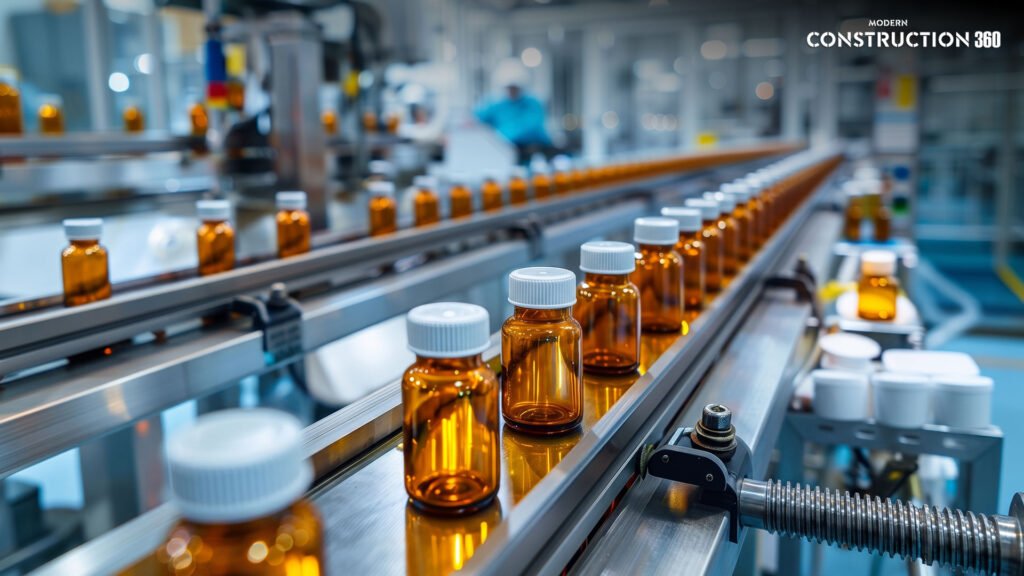
Every project like this begins with a question that has nothing to do with architecture: what, exactly, are we making, and who’s allowed to buy it? The type of product, a tablet, an injectable, a biologic, an active pharmaceutical ingredient- determines almost every downstream decision, because the regulatory guidelines, cleanliness levels, and engineering approach all shift depending on what’s being manufactured and how much of it.
If the plant is producing APIs rather than finished formulations, that’s a different animal entirely. API, or primary, manufacturing typically involves chemical reactors or biotech fermenters and multi-step purification, and it demands a different skill set and facility design than formulation-stage manufacturing, with its own dedicated GMP framework (ICH Q7) layered on top.
And then there’s geography. Which markets is this plant selling into? The U.S., the EU, Japan, all three? Drug and device manufacturing is overseen by a wide network of national regulatory agencies worldwide, and each one brings its own paperwork, inspection cadence, and design expectations. Pick the wrong regulatory strategy on day one, and you’ll be redesigning rooms two years in.
Picking a Site (and Why So Many Get Rejected)
Site selection sounds boring until you realize how many otherwise-solid candidates get thrown out. Power reliability, water quality, workforce availability, proximity to raw material suppliers, local permitting speed, any one of those can sink a location. Then there’s the layout question once the land is secured: components, containers, labeling materials, and finished product all have to move through the building in a way that prevents mix-ups, and the flow of materials through the facility has to be designed specifically to prevent contamination and configured so defined areas don’t cross-contaminate one another.
That’s not a suggestion. Premises need to be laid out so production happens in a logical sequence that matches both the order of operations and the required cleanliness levels at each stage. Get the adjacencies wrong, say, a raw-dust powder room sitting next to a sterile filling suite, and you’ve built yourself a very expensive redesign.
Designing Around the Product, Not the Building
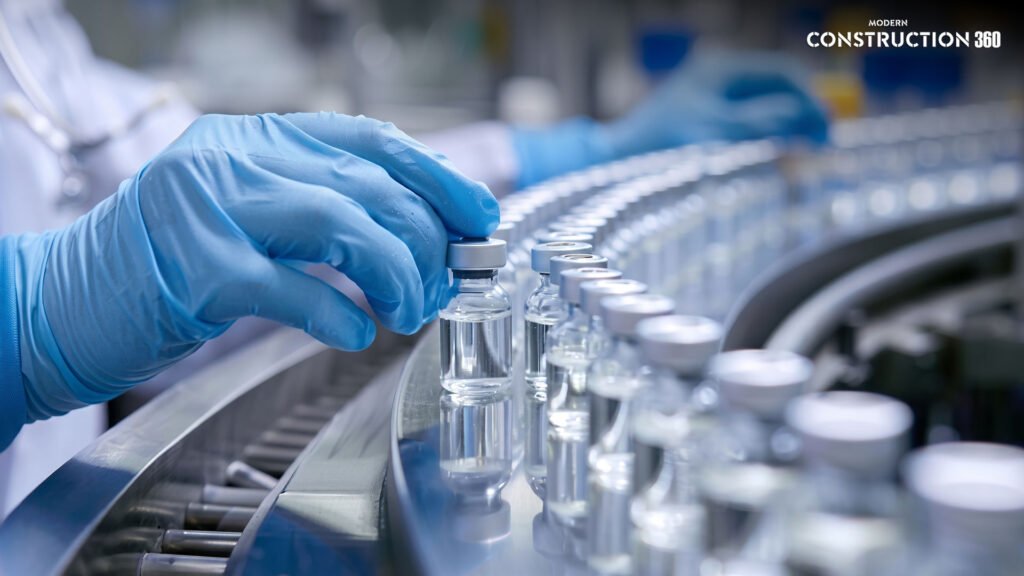
Here’s where a lot of first-time developers get surprised: you don’t design the cleanroom and then figure out what to make in it. You figure out the product first, then work backward into the room.
Cleanrooms Aren’t One-Size-Fits-All
Pharmaceutical cleanrooms are typically classified using ISO Classes 5 through 8 or GMP Grades A through D, standardized systems built around maximum allowable particle concentrations. Worth noting: you’ll still see the older “Class 100 / 10,000 / 100,000” language floating around facility documents; that’s a retired US federal standard, not the current ISO system, though the two roughly map onto each other. A sterile injectable line needs something close to an ISO 5 laminar-airflow core supported by an ISO 7 sterile gowning area and an ISO 8 gowning zone outside that, a nested set of rooms, each one cleaner than the last as you move toward the actual fill point.
Solid oral dose products (think tablets and capsules) don’t need anywhere near that level of sterility, but they bring their own headache: dust. Dry, dusty products like tablets or capsules carry a real cross-contamination risk, which is why engineers design pressure cascades with a clear “clean corridor” or “dirty corridor” philosophy so powder doesn’t migrate where it shouldn’t.
None of this happens without serious utility infrastructure sitting behind the walls. Purified water and water-for-injection systems run through sanitary stainless-steel piping loops and get tested microbiologically and chemically on a regular basis, alongside compressed air and nitrogen systems built to meet pharmacopeial purity standards. None of it is visible to a visitor walking the floor, and all of it is where a huge share of the budget quietly disappears.
How Long Does Developing a Pharmaceutical Manufacturing Facility Actually Take?
Timelines vary a lot by scale, but a documented construction-to-startup window for a biopharmaceutical plant runs roughly 18 to 36 months, and that’s before counting the years of upfront planning and post-startup validation batches. Larger, greenfield biologics campuses have historically taken longer still, with some large-scale builds in the mid-2010s reported at three to seven years including validation.
That timeline pressure is exactly why modular construction has caught on. Single-use technology and modular build approaches have meaningfully cut both capital costs and time-to-build compared with traditional stainless-steel facilities. A frequently cited case from the mid-2010s: JHL Biotech’s prefabricated KUBio plant, built by GE Healthcare Life Sciences, was assembled from 62 shipping containers in Wuhan, China, in just 11 days, a striking example of what modular design made possible at the time, though it’s now roughly a decade old and shouldn’t be read as a current benchmark.
The Money Side Nobody Talks About Enough
Ask five people what this costs, and you’ll get five wildly different answers, because the range genuinely is that wide. Estimates for building new biopharmaceutical manufacturing space range from roughly $500 to $1,400 per square foot, and that’s before accounting for equipment, validation, and the surrounding office and QC space.
The scale of individual company investments makes the range even more visible. Genentech’s Vacaville campus is a good real-world anchor here: the company’s own SEC filing confirms a planned Vacaville expansion expected to cost approximately $600 million, with the additional capacity intended to come online in 2009. More recently, Novartis committed $23 billion over five years in April 2025 to build six new US factories and expand three existing ones, and Eli Lilly committed at least $27 billion in February 2025 to build four new US manufacturing sites, bringing its total US manufacturing investment since 2020 to more than $50 billion.
Construction cost per square foot tells a similar story about how specialized this work is compared to standard industrial building, cGMP cleanroom infrastructure, redundant utilities, and the documentation trail regulators expect to see all add up fast, which is part of why cGMP cleanrooms and validation requirements alone can account for 35% to 55% of total capital expenditure on a pharmaceutical facility.
Getting the Regulators to Say Yes
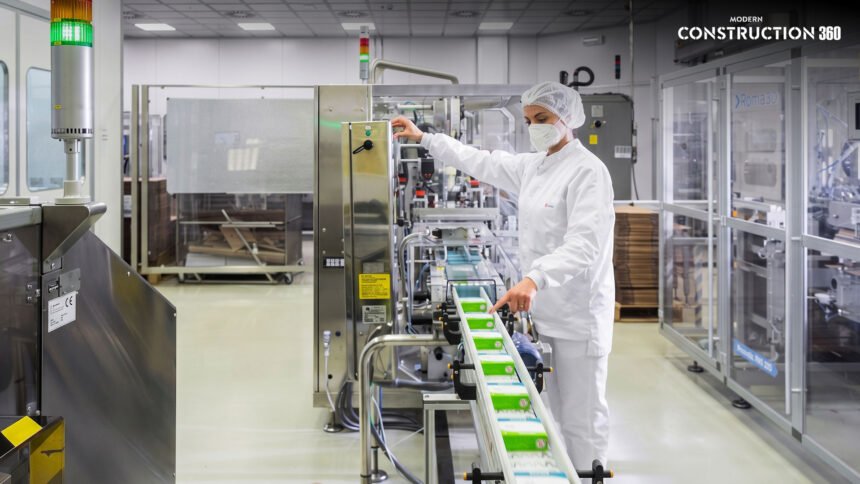
This is the part that trips up developers who think of GMP as a checklist rather than a mindset. GMP facilities need cleanable surfaces throughout, walls or floors with coved bases, step-downs between room classifications, segregation between personnel and material entry and exit points, and dedicated HVAC systems depending on the biological classification of the process. Every one of those requirements gets inspected, and every one gets documented.
Documentation is really the whole game here. Facility qualification follows a defined path: user requirement specifications through equipment installation, operation, and performance qualification, and that qualification sequence runs from Design Qualification through Installation Qualification, Operational Qualification, and finally Performance Qualification, ensuring equipment reliability, GMP compliance, and regulatory acceptance before a single commercial batch ships. BioProcess International
IQ OQ PQ, in plain terms, is the documented proof that your equipment was installed correctly, operates as designed, and performs consistently under real production conditions, and regulators from the FDA to the EMA won’t approve a facility without it.
The process typically closes out with three consecutive commercial batches manufactured using approved operating procedures, and only once all three meet specification is the equipment declared qualified for routine production. Miss a step, or skip the paperwork trail behind it, and an inspector will find it, usually at the worst possible moment.
Technology Transfer Is Its Own Minefield
Even a perfectly built facility can stumble here. Moving a process from a small-scale lab bench to full commercial equipment isn’t a simple scale-up; it’s a re-proving of the entire process at a different size, on different machines, sometimes on a different continent. A process that starts as hand manipulations on a tabletop in a lab environment has to mature into a fully characterized, often automated process by the time it hits commercial launch, and synchronizing process development with facility capability is what allows a plant to actually hit its design capacity when it opens.
Staffing a Facility Before It Even Opens
Here’s a piece that catches a lot of developers off guard: the building can be finished and validated, and you’ll still be scrambling for people to run it. According to BioPlan Associates’ annual industry survey, cited by analyst Eric Langer heading into 2026, a significant share of biopharma facilities report being unable to hire process development staff (36%), downstream production personnel (28%), and process engineers (27%).
Geography plays into this too. The same BioPlan Associates data shows only 28% of the world’s biopharmaceutical manufacturing staff are based in the US, with 72% located elsewhere, while tightening visa policies are making it harder to offset domestic shortages with international talent. A facility built in a region without an existing life-sciences labor pool, or a training pipeline feeding one, can sit validated and idle simply because there’s no one qualified to run the line. (Worth noting: staffing-industry sources tend to emphasize this gap heavily, since recruiting firms have a direct commercial stake in the shortage narrative; the underlying BioPlan survey data is the more neutral anchor here.)
The Digital Layer: MES and Data Integrity
Walk into a modern pharmaceutical plant, and the equipment is only half the story; the other half is software you can’t see from the floor. Manufacturing execution systems are built to replace paper-based processes with electronic batch records, and the regulatory push behind that shift is real: frameworks including FDA 21 CFR Part 11, EU Annex 11, and GAMP 5 are compelling pharmaceutical companies to adopt MES specifically to ensure data integrity and real-time compliance monitoring, and the pharmaceutical MES market is projected to grow from $2.37 billion in 2025 to $4.62 billion by 2030. (Much of the specific “why MES helps” framing in industry writing comes from MES vendors themselves; the regulatory drivers above are the independently verifiable part of that story.)
Where This Actually Leaves You
Developing a pharmaceutical manufacturing facility rewards patience and punishes shortcuts in almost equal measure. The companies that get it right treat facility design, regulatory strategy, process validation, staffing, and the digital systems running underneath it all as one continuous decision rather than five separate phases handed off between teams. Get the sequencing right: product first, then site, then design, then validation, then people and software, and the facility that comes out the other end isn’t just compliant. It’s built to actually hit its production numbers on day one, instead of spending its first year chasing them.